
Although I've been doing bits and pieces this summer, which you can keep up with on my shamelessly plugged Tumblr, it's been a while since I've done something substantial enough to warrant a blog post.
My friend FortressNebula1 and I worked on a game for the biggest game jam ever (whaat?!) GMTK 2026. The theme of the jam was Countdown, we had 96 hours to make a game from scratch, blah blah, I'm sure you've heard the whole spiel before.
Our finished product, made in 4 days in Godot, is called -
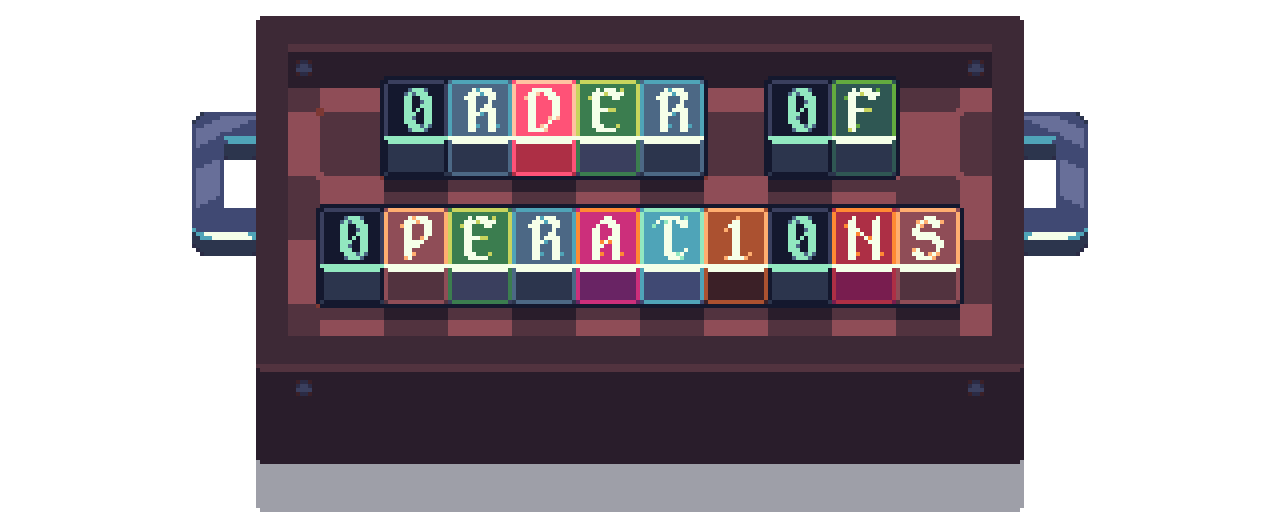
It's a puzzle game where you have to place operation blocks around a board so that they collapse all the numbers into 0s. The operation blocks act on number blocks around them, doing things like subtraction and multiplication.


Hopefully the puzzle above makes sense - the board is arranged so that the - subtracts the 7 and the 2 to make 5, while in the same stage the x multiplies the 2 and the 6 to make 12. This idea of multiple operation blocks using the same number block happens a lot. Once that stage goes through, the other remaining x now has a 5 and a 2 to work with - which are multiplied in the next stage to make 10!
It's a browser game, so you can actually play it right now! Probably not on mobile though.
There is a surprising amount of depth to a game like this - the 2 dimensional space gives you so much to work with, especially with more spatially exciting (and less mathematically relevant) operations like "swap" and "shadow swap".
Nebula is a big fan of grid-based puzzle games, so you can imagine the idea for Order of Operations arose pretty naturally from there. At base, it came from the 2048 goal of "collapsing the board"
We had a bunch of other ideas floating around; the ever-original indie Balatro clone is a hit staple of many unemployed teenage game developers, and almost ensnared us in its addictive-gameplay-loop-promising grasp, but the actual gameshow Countdown which we wanted to base it off of is really not that exciting or that fun. Nobody wants to literally do maths - I think the end result of OoO is about as close as you can get before attracting a very niche crowd/cult following of math nerds.
Expectant also was a factorio-like cellular automaton game where you had to "do operations" in an "order" (👀) to produce an expected result.

As you can see, this is the idea we actually got furthest with, but it proved too simple slash boring slash straightforward for a full game.
You must remember that I am by no means an artist, especially not an asset artist, and even more to the contrary a pixel artist. All assets were drawn by Fortress and his miraculous pixel art program.
I did an alright job on the SFX using basic oscillators in FL and BeepBox. Aside from that, programming work was split pretty evenly, granted with Nebula as the actual game dev having more experience using Godot and writing that special game developer flavour of spaghetti code. GDScript is a permissively messy language not helped at all by its similarities to Python, and I say that in a loving way.
Puzzles were also an absolute joy to design. There's something about the constrained space of the board that lends itself to natural discovery and \aha\ moments. Not to mention that the game gets pretty complicated by the end. I really think you should try it - I worked really hard to make the learning curve exciting, and mine and Nebula's levels are really interesting to crack.

I was even considering porting this game to the GBA (like that game which, mind you, I still haven't started making) or writing some more involved level editor because it just has so much potential as a puzzle game. For such an intriguingly simple concept, I really think me and Nebula stumbled across some gold here.
Once again - play it!